


What Kids & Teens Care About Most & Why We Should Too: New Survey

This week, Boys & Girls Clubs of America published our annual Youth Right Now survey — sharing insights from nearly 150,000 young people about their lives and not-so-distant futures.
This survey reflects the voices of young people who attend Boys & Girls Clubs — but the challenges they face are not unique. Like their peers across America, Club kids are part of Gen Z and Gen Alpha, two generations still navigating the aftershocks of social isolation, disrupted schooling and economic uncertainty — even five years after the pandemic.
Nationally, high school seniors have the lowest reading and math scores seen in decades.1 Nearly three-quarters (72%) of recent grads feel underprepared for life after high school2 while 40% of high schoolers say they feel persistently sad or hopeless.3
Amidst these challenges, our survey reveals inspiring progress made by Boys & Girls Club members as they report improved grades, form supportive communities, and build future-ready skills for adulthood.
It’s not easy being a young person today, which is why we conduct this survey to understand the changing needs of America’s youth. When we as a nation know what kids and teens need, we can better understand why investing in quality afterschool and summer programs is so essential, because these programs do make a difference in enabling more youth to become successful adults. These insights drive both our program development at Boys & Girls Clubs and our national advocacy to advance policies that benefit kids nationwide.
Right now, today’s kids are preparing to become tomorrow’s lawmakers, doctors, community leaders and innovators.
Based on this year’s survey, here’s what kids and teens want us to know so they can build great futures for themselves and us all.
Students Are Gradually Recovering in School
It’s been five years since the pandemic disrupted the world, and while students have been back in the classroom for a few years, the return to in-person learning hasn’t been easy.
The average U.S. student today is nearly half a grade level behind in math and reading compared to 2019.4 Meanwhile, 96% of 5th-12th graders attending Boys & Girls Clubs at least twice a week are on grade level for their age.
Research shows that students do better in school when they spend their non-school hours engaged in fun, academically stimulating activities. After school and during the summer months, Club kids build on what they’re learning through STEM labs, art classes, literacy workshops, career exploration programs and more. These advantages give students the extra boost they need to stay on track and avoid falling behind.
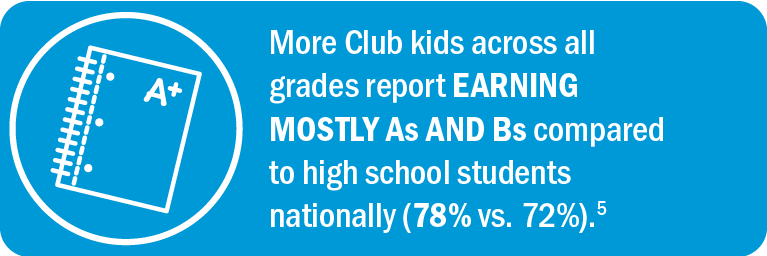

Along with focusing on their studies, it’s just as important for young people to understand all the possibilities for life after school. Our survey showed Club high school seniors embracing many different directions after graduation, with most planning to continue their education.
Among the graduating Class of 2024, only a third (35%) reported plans to pursue a four-year college degree.7 Nearly twice as many Club members in the graduating Class of 2025 (63%) said they plan to enroll in post-secondary education. Of those, three-quarters (77%) aim to earn a four-year college degree or higher.
Our survey also revealed that a third of Club high school students (29%) plan to be the first in their families to go to college.
As a parent, I understand the enormous preparation families face when it comes to college. This is significantly more challenging during a time when college costs are rising and student math and reading scores nationally are at their lowest in decades. That’s why it’s so important that every young person, no matter the circumstances that surround them, has access to the resources and support they need to pursue higher education if they choose.
At Boys & Girls Clubs of America, we’re committed to helping young people take that step by offering support from tutors and mentors during the school year and summer — from homework help and SAT/ACT prep to applications for colleges and financial aid.
Because when young people feel optimistic about their futures, they are more likely to reach their full potential.
Young People Care About Making their Community Better
Today’s young people are passionate about community issues, but not all feel equipped to create positive change, with only 43% of youth in national surveys feeling ready for civic action.8
In contrast, our survey shows that youth at Boys & Girls Clubs aren’t just participating in advocacy — they’re leading it.
Across more than 5,500 Clubs nationwide, we offer teens safe spaces, resources and mentorship to pinpoint issues they care about and spearhead service projects that make a direct impact on where they live. Young people want to improve the systems they were born into and these leadership opportunities instill the knowledge and confidence they need to take steps forward.
Teens at Boys & Girls Clubs also show higher volunteer rates compared to their peers.
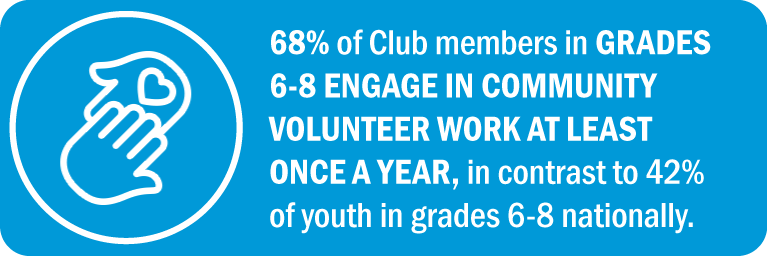

This data gives me hope that the next generation of leaders our world needs are already here, driving change and making a difference.
Exploring Careers & Learning “Adult Skills” are Teen Priorities
It’s hard to dream something you haven’t seen. That’s why it’s never too early to explore different careers; something 42% of recent high school grads nationally said they wished they’d done earlier.10
When tweens and teens know all their options, they can break through perceived and even real barriers to plan for a successful future. That’s why career readiness is a crucial part of what Boys & Girls Clubs do. From listening to speakers from different industries to job shadowing at local companies, Club members discover jobs that fulfill their interests and community needs.
Our survey not only showed that 88% of Club youth are aware of different career paths, but 86% already have one in mind.
This confidence carries into adulthood, with more Club adult alumni feeling satisfied with their careers compared to adults nationally (78% vs. 65%).11 However, this work goes beyond shaping individual success. By helping young people feel ready for life beyond high school, we’re strengthening the workforce, driving economic mobility, and securing a great future for our nation.
Being a successful adult also involves essential life skills, such as budgeting, preparing meals and updating your resume. Schools and parents often shoulder the responsibility for teaching youth these skills, however a broader support network will give them more support and opportunity for navigating adult life.
Boys & Girls Clubs offer after-school and summer programs for teens to gain real-world experience in meal preparation, creating a resume, mock job interviews and more.
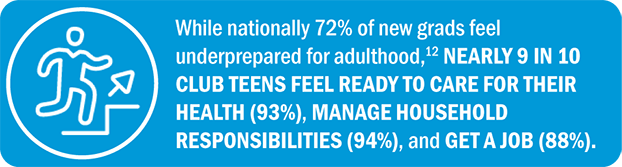
Half of young people nationally also say money issues stress them out.13
Boys & Girls Clubs offer programs that teach budgeting, saving and even opening a bank account, leaving 82% of Club teens feeling ready to manage their finances, compared to 63% of high schoolers and recent grads nationally.14
With so many teens committed to learning future-ready life skills, I see a resilient generation in the making, focused not just on surviving, but thriving.
Young People Seek Belonging
Many young people are entering adulthood with feelings of isolation. According to national surveys, 1 in 5 adults in their 20s feel disconnected from any community, while 1 in 3 crave a sense of belonging.15
To build community, young people often seek out extracurricular activities, sports, churches or community organizations. These spaces bridge the gap between school and home, ensuring kids’ physical and emotional needs are met.
Access to supportive communities, like those at Boys & Girls Clubs, from an early age can ignite kids’ confidence in expressing themselves authentically.
While 55% of high schoolers nationally feel close to people at school,16 91% of Club members surveyed in 2025 from grades 6-12 feel accepted for who they are and have a trusted adult to talk to about their problems at the Club.
Additionally, surveys in recent years from BGCA have shown that twice as many young people feel they can talk to an adult at the Club (80%) compared to an adult at school (40%).17
When youth feel understood, they are more likely to show understanding towards others. It’s up to us as adults to model healthy decision making and emotional regulation that teaches youth how to bridge divides and live harmoniously.
At a time when challenges in education, mental health, workforce readiness and belonging persist, young people are paying attention and striving for change. They are not just our future — they are our now.
While we have work to do in supporting young people’s well-being, relationships and future planning, I am confident that with adult partnership, positive change is near.
America needs Club kids, but Club kids also need us. Today’s young people are more determined than ever — driven by purpose, fueled by hope and ready to change the world. It’s up to us to stand with them and help turn their resolve into success.
Join us in investing in today’s kids and tomorrow’s leaders by:
- Becoming a Boys & Girls Clubs of America donor. Every dollar invested in Boys & Girls Clubs returns $10.32 in economic benefits to the youth we serve, their families and society.
- Signing up for our newsletter. Explore youth data trends and stories of young leaders in action that show exactly why America needs Club kids.

Jim Clark
President and CEO
Boys & Girls Clubs of America


